
How Many Watts Do You Really Need? Sizing Solar for Your 4WD
When embarking on an adventure in your 4WD, ensuring you have a reliable power source is crucial. Solar energy has become a popular choice for outdoor enthusiasts, providing a sustainable way to power your auxiliary systems. However, determining the right amount of solar power for your needs can be a daunting task. This guide will help you navigate the complexities of sizing solar panels for your 4WD, ensuring you have enough energy for your adventures.
Understanding Your Power Needs
Assessing Your Appliances
The first step in sizing your solar system is to identify the appliances you plan to use. Each device has a specific power requirement, typically measured in watts. Common appliances in a 4WD setup include:
Refrigerators: Often the largest power consumer, drawing anywhere from 30 to 100 watts per hour.
Lighting: LED lights are energy-efficient, usually consuming around 5 to 10 watts each.
Charging Devices: Phones, tablets, and laptops can vary significantly, with chargers typically drawing between 10 to 100 watts.
Other Equipment: Consider any additional devices such as fans, pumps, or entertainment systems.
Calculating Daily Usage
Once you have a list of your appliances, the next step is to calculate how long each will be used daily. This will help you determine the total watt-hours required. The formula is straightforward:
Watt-hours = Watts x Hours Used
For example, if your fridge uses 50 watts and runs for 12 hours, it will consume 600 watt-hours per day.
Total Daily Consumption
Add up the watt-hours for all your devices to get a comprehensive view of your daily power consumption. This total will guide your solar panel sizing.
Battery Capacity Considerations
Understanding Battery Types
Your solar system will need a battery to store energy for use when the sun isn’t shining. There are several types of batteries to consider:
Lead-Acid Batteries: These are commonly used and are generally more affordable but have a shorter lifespan and lower efficiency.
Lithium Batteries: More expensive but offer greater efficiency, longer life, and deeper discharge capabilities.
Calculating Battery Size
To determine the appropriate battery size, consider how much energy you’ll need to store. A good rule of thumb is to have a battery capacity that can handle at least 50% more than your daily consumption. For instance, if your total daily usage is 800 watt-hours, aim for a battery with at least 1200 watt-hours of capacity.
Sizing Your Solar Panels
Solar Panel Ratings
Solar panels are rated by their output in watts under ideal conditions. However, real-world performance can vary due to factors such as temperature, angle of sunlight, and shading. A high-quality panel may deliver around 80-85% of its rated capacity in practical use.
Calculating Required Solar Power
To calculate how much solar power you need, use the following formula:
Total Daily Consumption (Watt-hours) / Average Sunlight Hours = Required Solar Panel Output (Watts)
For example, if your daily consumption is 800 watt-hours and you expect an average of 5 sunlight hours, you would need:
800 Wh / 5 h = 160 W of solar panels
Adding a Safety Margin
It’s wise to add a safety margin to your calculations. A common recommendation is to increase your solar panel output by 20-30% to account for inefficiencies and less-than-ideal conditions. In our example, this would mean aiming for around 200 W of solar panels.
Choosing the Right Solar Setup
Fixed vs. Portable Panels
When selecting solar panels, you have the option of fixed or portable systems:
Fixed Panels: These are mounted on your vehicle and provide continuous charging while driving or parked.
Portable Panels: These can be moved to capture optimal sunlight and are ideal for camping setups.
Combining Systems
A combination of fixed and portable panels can offer flexibility and efficiency. For instance, a fixed panel can provide a baseline charge while portable panels can be adjusted throughout the day to maximise sunlight exposure.
Solar Charge Controllers
Importance of Charge Controllers
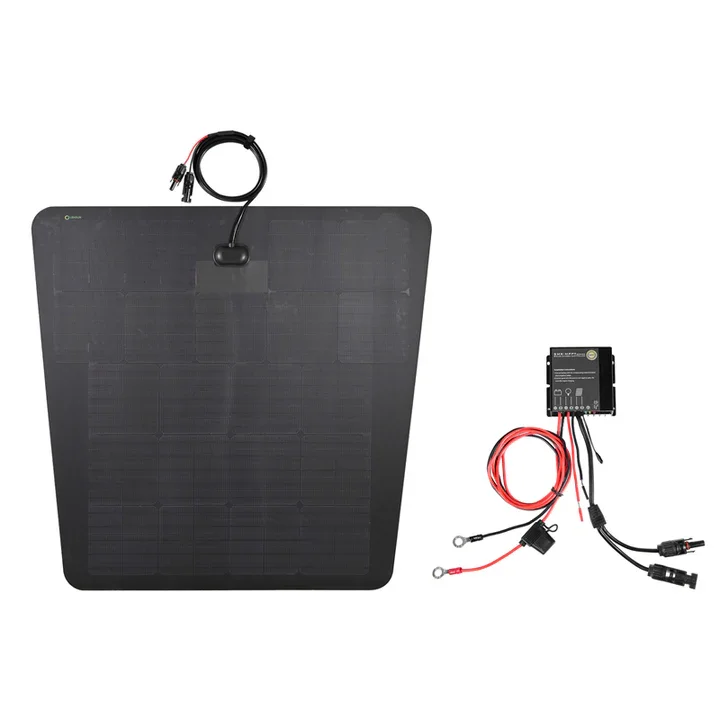
A solar charge controller is essential for regulating the voltage and current coming from your solar panels to your battery. This prevents overcharging and extends the life of your battery. There are two main types:
PWM (Pulse Width Modulation): More affordable but less efficient.
MPPT (Maximum Power Point Tracking): More expensive but maximises energy harvest from your solar panels.
Selecting the Right Controller
Choose a charge controller that matches your solar panel output and battery type. This ensures optimal performance and safety for your system.
Real-World Example
Scenario Setup
Let’s consider a practical example for a weekend camping trip. Assume you have the following appliances:
Fridge: 50 watts for 12 hours = 600 watt-hours
LED Lights: 10 watts for 4 hours = 40 watt-hours
Phone Charger: 20 watts for 2 hours = 40 watt-hours
Total Daily Consumption
Adding these together gives a total daily consumption of 680 watt-hours. To ensure you have enough battery capacity, you would need a battery rated for at least 1020 watt-hours (adding a 50% buffer).
Solar Panel Calculation
Assuming you have 5 hours of sunlight, the required solar panel output would be:
680 Wh / 5 h = 136 W
Adding a safety margin, you would aim for around 170 W of solar panels.
Maintenance and Efficiency Tips
Regular Cleaning
To maintain optimal performance, regularly clean your solar panels to remove dirt and debris that can block sunlight.
Monitor Battery Health
Keep an eye on your battery’s health and charge levels. Regularly check for any signs of wear or damage, especially if using lead-acid batteries.
Adjust for Seasonal Changes
Be aware that solar output can vary with the seasons. In winter, you may need to adjust your expectations and possibly increase your solar capacity.
Conclusion
Sizing your solar system for your 4WD is a critical step in ensuring you have the power you need for your adventures. By understanding your power requirements, selecting the right battery and solar panels, and incorporating a charge controller, you can create a reliable and efficient solar setup. With careful planning and consideration, you can enjoy the freedom of off-grid camping without the worry of running out of power.
By following these guidelines, you’ll be well on your way to harnessing the sun’s energy for your next outdoor adventure.
